
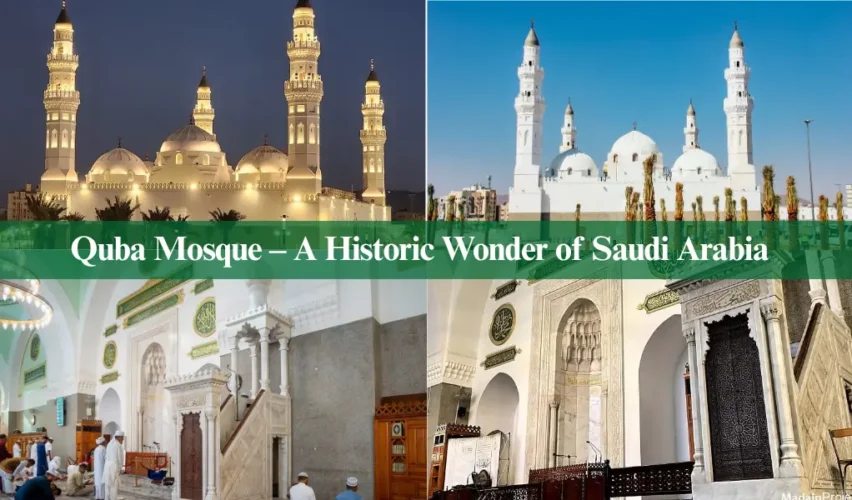
Saudi Arabia is home to many significant mosques. Among them is the first-ever mosque of Islam: Quba Mosque (مسجد قباء). It is located outskirts of Madinah and was founded by the Prophet Muhammad (ﷺ) himself during the Hijrah. With its serene architecture, deep-rooted history, and religious importance, masjid Quba is second to none. This blog is all about this glorious mosque, its features, and why it’s sacred for Muslims around the world.
| Quick Facts About Quba Mosque | |
| When Built | 622 CE (1 AH) |
| Where | Southwest of al-Madinah al-Munawwarah |
| Who Built It | Prophet Muhammad (ﷺ) and his companions |
| Current Area | 13,500 m² |
| Capacity | 20,000 worshipers |
| Minarets | 4 minarets |
| Domes | 62 white domes |
Where is Quba Mosque Located?
Masjid e Quba (مسجد قباء) is located in the southwest of al-Madinah al-Munawwarah, Saudi Arabia. It lies 3.5km away from Al-Masjid an-Nabawi (the Prophet’s Mosque). The location of the mosque is the district of Quba, and it is easily accessible to pilgrims visiting Medina during Hajj or Umrah.
When was Masjid e Quba Constructed?
Masjid e Quba (مسجد قباء) was constructed in 622 CE, during the Prophet Muhammad’s (ﷺ) migration from Makkah to Madinah. It was established shortly after his arrival in what was known as the Quba village in ancient times. It is considered the first mosque ever built in Islam and marked as a historic beginning for the Muslim community.
How was Masjid e Quba Named?
According to Yaqut al-Hamawi’s Mu’jam al-Buldan, Quba Mosque derives its name from the nearby Quba Well, which existed in the area. In earlier times, it was also referred to as the Bani Auf Mosque, named after the local tribe that resided in the region where the mosque was built.
What Is the Area of Quba Mosque?
Quba Mosque is the second-largest mosque in Madinah after the Prophet’s Mosque. It spans a land area of 13,500 square meters, and can accommodate around 20,000 worshipers at a time. The main prayer hall alone covers 5,035 square meters. It has ample space for congregational prayers. Architecturally impressive, the mosque features four minarets and sixty-two domes. It also includes facilities such as accommodations for imams and muezzins, a library, and a shopping area to serve the needs of worshipers and visitors.
Historical Background of Masjid e Quba
Quba Mosque holds a unique place in Islamic and Saudi History. After all, it is the first mosque ever established by the Prophet Muhammad (ﷺ). Upon arriving near Medina during the Hijrah (migration from Makkah), the Prophet paused in the area known as Quba. There, he personally took part in laying the foundation of the mosque. He worked alongside his companions to build this place of worship. This wasn’t just to preach Islam but this act set an example of humility, community effort, and devotion.
The mosque was established as soon as the Prophet arrived in Quba, marking the beginning of Islamic civilization in a new land. It symbolized a fresh start, the birth of a Muslim society, and the importance of building community institutions rooted in faith. Quba Mosque is one of the few mosques specifically mentioned in the Qur’an.
“A mosque founded on righteousness from the first day is more worthy for you to stand in.” – Surah At-Tawbah (9:108)
How Often Did the Prophet Visit Quba Mosque?
The Prophet Muhammad (ﷺ) would visit Quba Mosque (مسجد قباء) regularly to offer prayers, especially on Saturdays. He would make the journey either on foot or while riding to show the mosque’s spiritual significance. Moreover, the Prophet not only maintained this personal practice but also encouraged his companions and followers to visit the mosque and pray there.
Architectural Features of Quba Mosque
Quba Mosque has undergone several transformations since its original construction by the Prophet Muhammad (ﷺ). It was initially built with mud bricks and palm trunks; this construction reflected on the modest resources of the early Muslim community. Today, the mosque showcases a stunning modern design while preserving its historical essence. It features four tall minarets, sixty-two white domes, and a vast prayer hall that spans over 5,000 square meters. The surrounding complex includes spaces for learning, shopping, and accommodation. Over the centuries, Quba Mosque has been renovated by various rulers, most notably during the Ottoman and Saudi periods.
Quba Mosque: Modifications Before the Saudi Era
Masjid e Quba underwent several renovations and restorations that contributed to its evolving structure and significance. And many of these happened before the Saudi Era. The first major refurbishment was undertaken by Uthman Bin Affan, a companion of the Prophet and the third Caliph of Islam. Later, Umar Bin Abdulaziz made enhancements between 705–712, including the construction of additional structures and the mosque’s first minaret. Renovations continued over the centuries, with Abu Yaela al-Husayni contributing in 1044, followed by Jamal al-Din al-Isfahani in 1161. The mosque was also periodically restored in the years 1273, 1333, 1437, 1477, and had a major renovation in 1830, thanks to the efforts of various benefactors and Islamic rulers.
Quba Mosque During Saudi Rule
During the Saudi era, Quba Mosque received significant attention and development. In 1932, the founding King Abdulaziz Al Saud ordered the construction of a straight road connecting the Prophet’s Mosque to Quba Mosque to make access easier for visitors and pilgrims. Later, during the reign of King Faisal Bin Abdulaziz in 1968, the mosque’s external walls were renovated, and its northern section was expanded.
A major transformation occurred in 1985 under King Fahd Bin Abdulaziz, who launched a comprehensive expansion project. The mosque’s total area was increased from 1,600 m² to 13,500 m², including prayer spaces and service facilities. The mosque structure itself now spans 5,035 m². This project also included the reconstruction of the entire mosque to incorporate nearby land and preserve historical architectural features. The single original minaret was replaced with four elegant minarets, each standing 47 meters tall. These minarets were placed at the four corners of the mosque. This development modernized the mosque while honoring its sacred legacy.
King Salman’s Quba Mosque Expansion Project
The most ambitious expansion in the history of Quba Mosque (مسجد قباء) was launched under King Salman’s leadership. Announced on April 8, 2022 by the Crown Prince, this historic project aims to increase the mosque’s total area to an impressive 50,000 square meters. This is ten times its pre-expansion size. Once completed, the mosque will be able to accommodate approximately 66,000 worshipers.
The project focuses on the following:
- Creating shaded prayer areas and independent prayer spaces
- Improved infrastructure to support large crowds during peak seasons
- Enhanced safety measures and visitor services
- Revitalization of 57 historical sites nearby.
This major development aligns with Saudi Vision 2030, particularly its Quality of Life and Pilgrim Experience programs.
Timeline of Quba Mosque Renovations | ||
| Year / Period | Leader / Authority | Details |
| 622 CE | Prophet Muhammad (ﷺ) | Original construction using mud bricks and palm trunks during the Hijrah. |
| 644–656 CE | Caliph Uthman ibn Affan | First known structural expansion to accommodate more worshipers. |
| 705–712 CE | Umar bin Abdulaziz | Major expansion and addition of the first minaret. |
| 1044 CE | Abu Ya‘la al-Husayni | Restoration and enhancement during the Abbasid period. |
| 1161 CE | Jamal al-Din al-Isfahani | Structural renovation and upkeep. |
| 1273, 1333, 1437, 1477 CE | Various Islamic Rulers | Periodic restorations to maintain structural integrity. |
| 1830 CE | Ottoman Empire | Major restoration; architectural enhancements and reinforcement. |
| 1932 CE | King Abdulaziz Al Saud | Ordered construction of a direct road connecting Quba to the Prophet’s Mosque. |
| 1968 CE | King Faisal Bin Abdulaziz | Renovation of external walls and northern expansion. |
| 1985 CE | King Fahd Bin Abdulaziz | Expansion from 1,600 m² to 13,500 m², addition of four minarets, complete architectural overhaul. |
| 2022 CE | King Salman (announced by Crown Prince Mohammed Bin Salman) | Largest expansion in history to 50,000 m² and 66,000 worshiper capacity. |
The Quba Front Project
The Quba Front Project was launched as part of the City Humanization Program led by the al-Madinah Region Development Authority. The centerpiece of the project is a 3-kilometer pedestrian-friendly pathway that links Quba Mosque with the Prophet’s Mosque. The main reason was to improve accessibility and comfort for residents and pilgrims to enhance both the spiritual and urban experience.
The route is lined with residential towers and hotels. There are also retail shops selling a variety of local goods such as sweets, traditional foods, clothing, children’s toys, gold, and jewelry. Dedicated spaces support local artisans and producers and help preserve the region’s cultural identity within a modern, well-planned environment.
The pathway is fully paved and accessible, including facilities for people with disabilities. This makes it especially valuable during Ramadan and Dhul-Hijjah, when foot traffic increases big time. Aesthetic enhancements were also made: building facades were unified in color, and shop designs were standardized to create a visually pleasing experience.
Did You Know?
The Quba Front Project was awarded Best Tourist Attraction Site in Saudi Arabia in 2018.
Important Places Near the Quba Mosque
The area surrounding Quba Mosque is rich with historical landmarks. These sites are not only spiritually significant but also serve as valuable destinations for visitors seeking to connect with the early days of Islam. Here are three key places located near Quba Mosque that are worth visiting:
– Al-Jumuah Mosque
It is located approximately 900 meters north of Quba Mosque. Al-Jumuah Mosque is also known as Al-Wadi Mosque, Al-Qubayb Mosque, or Aetikah Mosque. It marks the spot where the Prophet Muhammad (ﷺ) offered the first Friday (Jumuah) prayer in Madina. This moment took place in the valley of Ranunaa while the Prophet was migrating from Makkah to Madina and had temporarily stopped in Quba. The original mosque was built with stone and has been renovated several times throughout history. A major expansion was completed in 1991 under King Fahd Bin Abdulaziz to increase its capacity to 650 worshipers, up from just seventy. Its historical relevance makes it a must-visit site for those exploring Madina’s Islamic heritage.
– Ghars Well
It is one of the oldest and most historically important wells in Madina, and is roughly 1,500 meters northeast of Quba Mosque. It is believed to be over 1,500 years old. Moreover, this well is constructed of basalt stones, typical of the region. It has been mentioned in Islamic texts and holds significance due to its close association with the Prophet Muhammad (ﷺ). Restoration efforts have made the site accessible and safe for visitors, with protective iron barriers surrounding the well and a prayer area nearby. Water continues to be drawn from the well for those visiting, and the surrounding area is paved with natural rocks
– Quba Castle
Quba Castle, located near Quba Mosque, stands as a reminder of Madina’s strategic and defensive past. This historic fort was constructed in 1915 to monitor and protect the southern entrance to the city. The structure spans about 218 square meters, comprising a ground floor, two upper levels, and a rooftop. Its architecture features black volcanic stone walls, coated with white Madinian plaster (al-Nourah) and gypsum. The northern-facing main entrance is topped with a prominent entrance tower. Restoration work overseen by the General Authority for Tourism and Antiquities has helped preserve the castle, including foundation reinforcement, wall treatment, and ceiling repairs.
These sites near Quba Mosque offer a rich experience for anyone wishing to explore the Islamic history and the culture of al-Madinah al-Munawwarah.
Lesser-Known Facts About Quba Mosque
While Quba Mosque is widely known as the first mosque in Islam, there are several lesser-known facts that add depth to its spiritual and historical significance:
- Weekly Visit by the Prophet (ﷺ): It was the Prophet Muhammad’s (ﷺ) regular practice to visit Quba Mosque every Saturday.
- First Jummah Prayer. Quba Mosque is also the place where Salat al-Jumuah (Friday Prayer) was openly established for the first time, marking a historic moment in Islamic history.
- Reward Equal to Umrah: According to Hadith, praying two rak’ahs at Quba Mosque holds the reward equivalent to performing an Umrah.
- Mentioned in the Qur’an: Quba Mosque is indirectly referenced in Surah At-Tawbah (9:108) as a mosque founded on piety and righteousness from the very first day.
- Eco-Friendly Renovations: In recent years, efforts have been made to enhance the mosque’s sustainability, including better water management systems, energy-efficient lighting, and improved accessibility features for people with disabilities.
- Community Hub: Beyond worship, Quba Mosque has served as a community center throughout Islamic history. It’s been a place for education, justice, and social gathering.
Conclusion
Masjid Quba, the oldest Mosque in Islam, stands as a symbol of faith, history, and unity. It was built by Prophet Muhammad (ﷺ) and his companions, and later went through grand expansions under modern Saudi leadership. From day one to now, it continues to inspire millions of Muslims around the world. Its spiritual significance, architectural beauty, and surrounding landmarks make it a must-visit destination for pilgrims and tourists.